 Arabic
 English
 French
 German
 Spanish
 Portuguese
 Dutch
 Italian
 Russian
 Chinese
 Japanese
 Korean
 Indonesian
 Thai
 Vietnamese
 Turkish
 Hebrew
 Hindi
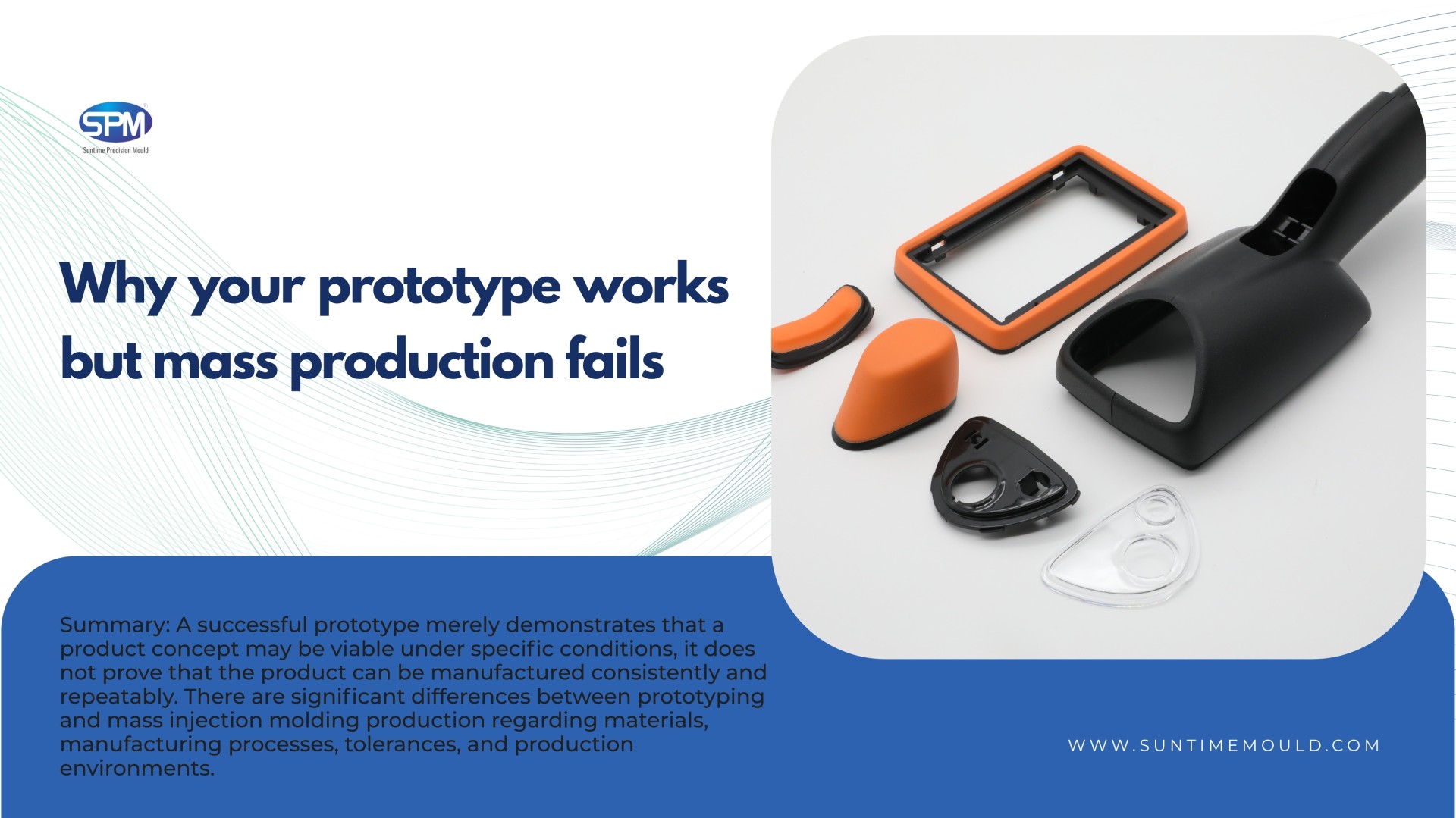
Summary: A successful prototype merely demonstrates that a product concept may be viable under specific conditions, it does not prove that the product can be manufactured consistently and repeatably. There are significant differences between prototyping and mass injection molding production regarding materials, manufacturing processes, tolerances, and production environments. This article analyzes the primary reasons why products often fail when transitioning from rapid prototyping to mass production, and explains how risks can be mitigated through Design for Manufacturing (DFM) analysis, engineering validation, and small-batch trial production.
When a prototype functions as intended, a team might assume the product is nearly complete. However, once the product enters mass production, issues such as shrinkage, deformation, assembly difficulties, inconsistent aesthetics, and functional failures may arise simultaneously.
The reason for this is that prototyping validates whether a design *can* work, whereas mass production validates whether that design can be manufactured consistently and reliably at a reasonable cost.
1. Prototyping processes differ from mass-production processes.
Prototypes may be created using 3D printing, vacuum casting, or CNC machining, whereas mass production might employ plastic injection molding.
CNC machining involves removing excess material from a part, whereas injection molding requires molten plastics to be forced into a plastic injection mold cavity under pressure, followed by a holding (packing) phase and cooling. Consequently, a design that functions perfectly during the prototyping stage may encounter issues—such as sink marks, weld lines, trapped air, warpage, or ejection difficulties—when produced via injection molding.
Before manufacturing an injection mold, it is not enough to simply replicate the prototype’s structure; the design must be re-evaluated in the context of actual mass-production processes. Typically, SPM assists clients by conducting a DFM (Design for Manufacturability) analysis to assess the moldability of a plastic component, covering aspects such as draft angles, the risk of sink marks, gate locations, and more.
2. Prototyping materials may not fully represent materials intended for mass production.
Materials that appear similar do not necessarily possess the same mechanical properties. For instance, 3D-printable ABS-like materials may differ significantly from genuine injection-molding-grade ABS in terms of strength, interlaminar bonding, heat resistance, and shrinkage movement.
Even when the same material name is used, variations in specific grade, additives, glass fiber content, and the proportion of recycled material can all affect dimensions, appearance, and performance. Material validation must be specific to the exact grade, and engineering sample testing should, whenever possible, be conducted using the same materials planned for mass production.
3. A single acceptable sample does not prove process stability.
An experienced technician might produce a well-functioning prototype by adjusting equipment and performing manual refinements; however, mass production requires the consistent manufacture of hundreds or even tens of thousands of units.
Factors such as material batches, ambient temperature, equipment condition, tool wear, and molding parameters are all subject to fluctuation. If a design has not been thoroughly considered, even minor variations can lead to defects. Evaluating mass production requires looking beyond the “best-case sample” to determine whether consistency can be maintained across multiple production cycles and different batches.
4. The product is designed not suitable for mass production
Issues common in the prototyping stage—such as sharp corners, abrupt changes in wall thickness, excessively deep ribs, a lack of draft angles, or uneven wall thickness—might be overlooked when producing a single unit. However, these factors directly impact mold machining, plastic flow, cooling, and part ejection.
Mass production requires the creation of molds. In such cases, SPM normally assists clients by making a DFM analysis. This process not only verifies whether the product can be manufactured but also determines whether it can be produced using a stable process and at a reasonable cost.
5. Dimensions may be within tolerancebut assembly can still fail
Even if every individual part falls within the tolerances specified on the drawing, the final assembly may still fail to meet requirements. When multiple dimensions accumulate along the direction of assembly, it can lead to excessive gaps, interference, misalignment, or a loss of sealing—a phenomenon known as “tolerance stack-up.”
Consequently, engineering teams must conduct tolerance analysis to identify the critical dimensions that genuinely impact functionality, rather than applying equally stringent tolerances to every dimension. Overly tightening tolerances on non-critical dimensions only serves to increase manufacturing costs.
6. Mold design will affects product stability
Gate location, venting, cooling channels, ejection methods, and cavity layout all can influence products’ quality. Even with a good product design, issues such as uneven cooling or inadequate venting in the mold can lead to deformation, burning, dimensional drift, or inconsistent cycle times during mass production of injection molding.
Mold reviews should not be limited to whether the mold can open and close properly, they must also account for filling balance, cooling efficiency, ease of maintenance, and long-term production lifespan.
7. Laboratory testing cannot fully represent real-world usage.
Prototypes may only be tested at room temperature and over short durations; however, mass-produced products must withstand challenges such as transport-related vibration, drops, temperature extremes (high and low), humidity, UV exposure, chemical exposure, or long-term cyclic loading.
Testing should be developed based on the product’s actual operating environment. For critical functions, testing should extend beyond the initial sample to include units from different production batches, as well as samples with specifications near the tolerance limits.
8. Mistake of Skipping small-batch trial productionand making mass production directly
Moving directly from a rapid prototyping to full-scale mass production risks rapidly replicating as-yet-undiscovered issues. A safer approach is to have a small-batch trial run to validate production cadence, assembly methods, inspection standards, packaging protocols, and supply chain coordination.
The goal of a trial run is not to achieve the lowest possible unit cost, but to confirm that the entire manufacturing system can operate reliably.
A successful prototype is an important starting point for product development, not an authorization for mass production. A truly robust preparation for mass production should encompass clearly specified material grades, complete technical drawings, tolerance analysis, DFM reviews, injection mold testing, engineering validation, and small-batch trial production.
Effective quality control in mass production is not about screening out defective units before shipment; it is about minimizing the likelihood of defects arising during the design and process phases. For a product team, the most critical question is not merely “Does this sample work?” but rather, “If we switch to a different batch of materials or a different operational shift, will the product still function correctly when the ten-thousandth unit rolls off the line?”
Suntime Precision Mould has helped many projects from rapid prototyping to mass production by providing injection mold making, injection molding service, CNC machining and other engineering outsourcing service. We have experieced many times from the design to final parts.