 English
 French
 German
 Spanish
 Portuguese
 Dutch
 Italian
 Russian
 Chinese
 Japanese
 Korean
 Indonesian
 Thai
 Vietnamese
 Arabic
 Turkish
 Hebrew
 Hindi
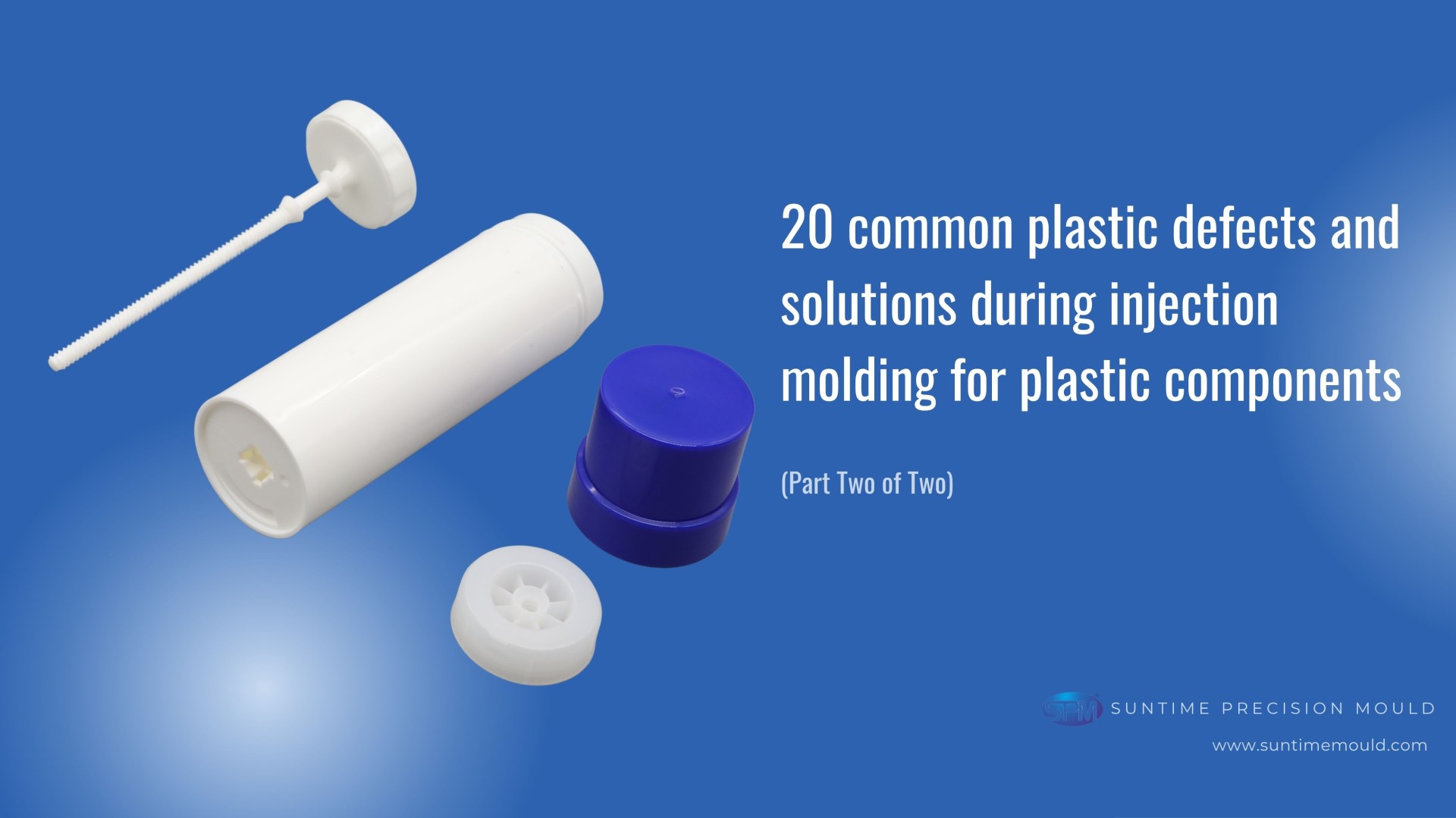
20 common plastic defects and solutions during injection molding for plastic components
Summary: After years in injection molding business, the thing we fear most isn’t tight deadlines. It’s the endless list of problems that pop up such as short shot, flash, sink marks, weld lines, burn marks, sticking parts and so on.
But here’s the truth. We’ve hit every single one of these 20 common trial issues based on many years’ working experience at Suntime Precision Mould. Some took days to solve. Others were fixed in five minutes with a fresh perspective.
Below is a list we’ve built from countless trials for reference. Hope it helps for your plastic components.
- Short shot(Incomplete Filling)
Causes: Insufficient injection pressure/speed; low material/mold temperature, insufficient gate/runner; poor venting; poor material flowability; insufficient metering by the injection molding machine.
Solutions:
* Increase injection pressure and speed
*Increase barrel temperature (especially nozzle temperature)
* Increase mold temperature
* Enlarge gate/runner or increase the number of gates
* Check if the gate solidifies prematurely, adjust gate position
* Add venting channels, especially in air-trapping areas
* Check if the material is sufficiently dry to avoid moisture affecting flowability
* Use a material grade with better flowability
* Check if the injection volume of the injection molding machine is sufficient, increase metering stroke
* Check if the check ring is worn to prevent injection backflow
* Check if the nozzle is clogged or has poor fit with the sprue bushing
* Check if the mold is too tight, causing venting obstruction
* Use multi-stage injection to optimize the filling speed curve
- Flash (Flash)
Causes: Insufficient clamping force, damage or foreign objects on the mold parting surface, excessive injection pressure, excessive material temperature, insufficient mold rigidity, malfunction of the mold clamping mechanism.
Solutions:
*Increase clamping force.
* Reduce injection pressure or speed.
* Lower barrel and mold temperatures.
* Check the parting line for foreign objects, burrs, or damage; repair the mold if necessary.
* Check mold parallelism; adjust template parallelism.
* Check mold support pillars for sufficiency; add support to prevent template deformation.
* Check injection machine guide pillar tension for uniformity; adjust mold thickness balance.
* Check mold inserts for looseness or protrusion above the parting line.
* Check ejector plate for proper return to position; prevent ejector plate retraction delay. Reduce holding pressure and holding time.
* Check mold venting grooves for excessive depth; reduce depth appropriately. * For large molds, increase clamping force or replace with a higher-tonnage injection machine.
* Check that slides, angled ejectors, and other core-pulling mechanisms are fully reset before mold closing.
- Shrinkage Marks (Surface Depressions)
Causes: Insufficient holding pressure, premature gate curing, uneven wall thickness, uneven cooling, high material shrinkage, insufficient injection volume.
Solutions:
* Increase holding pressure and holding time.
* Extend cooling time to ensure full curing.
* Increase gate size or change gate location to extend the holding pressure and shrinkage compensation channel.
* Optimize wall thickness design to avoid localized excessive thickness.
* Add reinforcing ribs or reduce material thickness in thick-walled areas.
* Increase mold temperature to delay gate freezing time.
* Increase barrel temperature to improve flowability.
* Check for check ring leakage to ensure effective holding pressure.
* Check injection volume on the injection molding machine and increase metering.
* Adjust multi-stage holding pressure curves for segmented shrinkage compensation.
* Check if cooling water channels are too concentrated or missing in thick-walled areas.
* Use a material with lower shrinkage.
* Add gas-assisted or foaming processes (if applicable).
- Weld Lines (Obvious Joint Lines)
Causes: Low material flow convergence temperature, poor venting, poor material flowability, slow injection speed, low mold temperature, insufficient wall thickness.
Solutions:
* Increase melt and mold temperatures
* Increase injection speed to facilitate rapid material flow convergence
* Add venting channels or venting bars at the weld line location
* Change gate location to relocate the weld line to a non-visual or stress-bearing area
* Increase the number of gates and alter the filling pattern
* Use hot runner sequence valves to control and adjust material flow convergence time
* Increase back pressure to improve plasticizing quality
* Check material dryness to avoid moisture interference
* Increase wall thickness or add localized reinforcement
* Use vacuum venting or auxiliary vacuum devices
* Switch to a material with better flowability
* Locally increase mold temperature in the weld line area (e.g., by adding heating rods)
* Apply release agent or lubricant to improve flow (caution advised)
- Burning
Causes: Trapped air causing adiabatic compression, excessively high material temperature, excessively fast injection speed, material degradation, and material accumulation due to screw wear.
Solutions:
* Add or enlarge venting channels, especially in the final filling area.
* Reducing injection speed to decrease compressed air temperature.
* Reducing barrel and nozzle temperatures.
* Checking for excessive screw speed to avoid excessive shear heat.
* Shortening the molding cycle to reduce material residence time in the barrel.
* Clean carbon deposits from the barrel, screw, and hot runner.
* Checking for dead zones and material accumulation in check rings, flanges, etc.
* Using a vacuum venting system.
* Checking for material decomposition due to heat; replacing the material if necessary.
* Optimizing multi-stage injection, slowing down at the end of filling.
* Checking for mold venting blockage by oil or debris.
* Using a material with better heat resistance.
- Snake-like marks (spray marks)
Causes:Excessively fast injection speed, insufficient gate size, improper gate location (directly impacting the cavity), and excessively low melt temperature.
Solutions:
Reducing injection speed by using a low-speed gate followed by acceleration.
Increasing gate size or changing gate type (e.g., fan-shaped, ear-type, or overlapping gate).
Changing gate location to ensure the melt impacts the core or wall.
Increasing melt and mold temperatures.
Using a needle valve hot runner system to control gate opening timing.
Optimizing mold design by adding a buffer zone behind the gate.
Checking if the gate is directly opposite ejector pins or inserts, causing flow turbulence.
- Warpage
Causes: Uneven cooling, anisotropic shrinkage, improper holding pressure, unbalanced mold temperature, insufficient cooling during demolding, excessive molecular orientation.
Solutions:
* Optimize cooling water channel layout to ensure uniform mold temperature.
* Increase the number of cooling water channels and shorten cooling time.
* Adjust holding pressure and holding time to avoid over-holding pressure.
* Reduce mold temperature or balance the temperature difference between moving and fixed molds.
* Extend cooling time to ensure sufficient curing before demolding.
* Check for uniform ejection to avoid ejection deformation.
* Optimize gate location to reduce molecular orientation.
* Use annealing (post-processing).
* When using glass fiber reinforced materials, pay attention to glass fiber orientation control.
* Adjust mold temperature to compensate for deformation in the opposite direction.
* Check product structure and add reinforcing ribs or anti-deformation design.
* Optimize process window using mold flow analysis.
* Check injection molding machine platen parallelism and ejection balance.
- Color Difference (Uneven Color)
Causes:Fluctuating material temperature, uneven mixing, improper screw speed, material degradation, poor masterbatch dispersion, incomplete cleaning of the previous colorant.
Solutions:
* Stabilize barrel temperature to prevent fluctuations
* Increase back pressure to improve mixing effect
* Adjust screw speed to improve plasticization uniformity
* Check the accuracy of the color masterbatch ratio and use color masterbatch or color powder for uniform mixing
* Clean the screw, barrel, and hot runner to thoroughly remove residual material
* Check if the material has yellowed due to heat degradation
* Shorten the molding cycle and reduce the material’s residence time in the barrel
* Check the accuracy of the injection molding machine’s temperature control and calibrate the thermocouples
* Use professional cleaning materials for color change
* Check material batch consistency
* Adjust holding pressure parameters to prevent color differences due to density variations.
- Silver streaks ,watermarks, air bubbles
Causes: Insufficient material drying, material degradation, air contamination, screw overheating, poor venting, impurities.
Solutions:
* Thoroughly dry the material to ensure the moisture content meets standards (depending on material type).
* Increase back pressure to prevent air entrapment.
* Lower the barrel temperature to prevent material degradation.
* Check if the hopper is absorbing moisture; use a drying hopper.
* Reduce screw speed to decrease shear heat.
* Check the check ring and screw for wear to prevent melt leakage.
* Add venting channels or improve mold venting.
* Check if the gate is too small, causing excessive shear heat.
* Check if different types of materials or impurities are mixed in.
* Use a vacuum venting system.
* Check if the injection molding machine nozzle is clogged or contains cold material.
- Delamination/Peeling (over molding)
Causes: Material incompatibility, moisture or impurity contamination, low material temperature leading to poor welding, excessive shearing, excessively high recycled material ratio.
Solutions:
* Thoroughly dry the material to remove moisture.
* Avoid contamination with incompatible materials (e.g., different plastic types).
* Increase melt temperature to improve interlayer bonding.
* Increase injection speed to enhance weld strength.
* Reduce the proportion of recycled material (sprue).
* Check for foreign matter or degraded material.
* Adjust screw speed to avoid excessive shearing.
* Check mold venting for proper function.
* Use a material combination with better flowability.
* Clean the barrel and hot runner to remove residual material.
- Flow Marks
Causes: Slow injection speed, low mold temperature, low melt temperature, insufficient gate size, insufficient wall thickness.
Solutions:
* Increase injection speed to quickly fill the cavity.
* Increase mold temperature and melt temperature.
* Increase gate size to reduce shear rate.
* Change gate location for smoother flow.
* Use multi-stage injection, slow injection at the gate area followed by rapid injection.
* Increase wall thickness or localized thickening.
* Check for insufficient surface finish of the mold.
* Use hot runners to increase the temperature at the gate.
- Sticking to the Mold
Causes: Insufficient draft angle, inadequate core polishing, undercuts on the mold surface, poorly designed ejection system, insufficient cooling time, excessive holding pressure.
Solutions:
* Increase draft angle (usually 1°-3° or more)
* Polish core surface to sufficient smoothness
* Check for undercuts or minor scratches, and repair the mold
* Increase the number of ejector pins or use ejector plates/blocks for ejection
* Extend cooling time to ensure sufficient curing and shrinkage
* Reduce holding pressure and holding time to reduce clamping force
* Spray release agent or anti-stick coating on core surface
* Check for smooth ejector plate reset
* Increase ejection speed and stroke
* Check if mold temperature is too high, causing insufficient shrinkage
* Use air-assisted ejection or add an air blowing device
* Check if the material has strong mold adhesion (e.g., soft rubber), and use a suitable material.
- Internal Bubbles
Causes: Excessive wall thickness, insufficient holding pressure, premature gate solidification, high material shrinkage, excessively high or low mold temperature, poor venting.
Solutions:
* Increase holding pressure and holding time
* Increase gate size and extend the holding and shrinkage compensation channel
* Optimize wall thickness design to avoid localized excessive thickness
* Lower mold temperature to accelerate surface solidification
* Increase melt temperature to improve shrinkage compensation capability
* Check if the gate freezes prematurely and adjust the gate position
* Use multi-stage holding pressure and gradually reduce pressure
* Check venting for good results to prevent internal gas residue
* Use a material with lower shrinkage rate
* Use gas-assisted or foaming processes
- Black Spots
Causes: Carbon buildup on the barrel or screw, thermal degradation of the material, material accumulation in hot runner dead zones, impurities mixed in the raw material, carbon deposits adhering to the mold surface.
Solutions:
* Thoroughly clean the screw, barrel, and hot runner.
* Reduce barrel temperature to prevent prolonged material residence time.
* Regularly clean with professional cleaning materials.
* Inspect the hot runner for dead zones or uneven heating.
* Check raw material cleanliness and control recycled material quality.
* Clean carbon deposits and oil from the mold surface.
* Shorten molding cycle time and reduce material residence time.
* Inspect the check ring and screw head for wear or carbon buildup.
* Change material batches to prevent impurities from entering.
* Check environmental cleanliness to prevent foreign objects from falling in.
- 15. Excessive Gate Residue (Gate Protrusion)
Causes: Improper gate cut-off timing, unreasonable gate design, excessive holding pressure, excessive material toughness, gate stringing.
Solutions:
* Optimize gate type (e.g., diving gate, needle valve, point gate)
* Adjust gate cut-off position (add cold slug well)
* Use needle valve hot runner to precisely control gate closing time
* Adjust holding pressure switching position and holding pressure
* Extend cooling time to ensure full gate solidification
* Adjust ejection speed and ejection timing
* Check for gate sleeve wear or roughening, polish accordingly
* Lower melt temperature to increase gate solidification speed
* Adjust ejection amount to prevent gate stringing.
- Unstable Dimensions
Causes: Unstable molding cycle, temperature fluctuations, holding pressure fluctuations, material batch differences, uneven mold temperature, poor equipment stability.
Solutions:
* Stabilize molding cycle (cooling time, holding time, metering time)
* Ensure stable mold temperature using a mold temperature controller for precise control
* Stabilize barrel temperature and calibrate thermocouples
* Ensure stable injection machine back pressure and holding pressure
* Check for wear on the check ring to prevent injection volume fluctuations
* Use closed-loop control for the injection machine to improve accuracy
* Stabilize material batches and control the recycled material ratio
* Check for consistent screw metering positions
* Extend cooling time to ensure full product curing
* Control ambient temperature and humidity
* Perform post-treatment (annealing, humidity conditioning) to eliminate internal stress。
- Uneven Wall Thickness
Causes: Uneven filling leading to excessive pressure on one side; insufficient core support; insufficient mold rigidity; excessive injection speed; uneven clamping force.
Solutions:
* Optimize filling balance to ensure even pressure on both sides.
* Add core support pillars or reinforce the structure.
* Add mold interlocking mechanisms (e.g., conical surfaces, stops).
* Reduce injection speed and injection pressure.
* Adjust gate position to avoid excessive lateral pressure.
* Check the parallelism of the injection molding machine template and the uniformity of clamping force.
* Increase core diameter or use high-strength steel.
* Use multi-stage injection to reduce end-pressure impact.
* Adjust ejection balance to avoid secondary misalignment.
- Air Trap
Causes: Insufficient or blocked venting channels; excessive filling speed; melt front surrounding gas; improper gate position causing gas accumulation.
Solutions:
* Add venting channels, depth determined by material properties (typically 0.01-0.05mm)
* Use venting steel (porous material) inserts
* Reduce injection speed, especially at the end of filling
* Adjust gate position to direct gas flow towards the venting channels
* Add a vacuum venting system
* Check venting channels for blockage by oil or debris, and clean them regularly
* Add inserts to trapped gas areas to utilize gaps for venting
* Use multi-stage injection, slowing down or pausing at trapped gas locations
* Modify product structure to avoid forming closed gas cavities。
- Insufficient Gloss (Surface Haze)
Causes: Low mold temperature, slow injection speed, insufficient mold surface finish, poor material flowability, residual mold release agent, gas corrosion.
Solutions:
* Increase mold temperature
* Increase injection speed and pressure
* Polish mold surface to a higher gloss level
* Check mold surface for oil or scale and clean thoroughly
* Reduce holding pressure to avoid over-compaction leading to haze
* Check material for sufficient dryness
* Adjust gate position to prevent cold material from entering the cavity
* Check venting for proper ventilation to prevent gas corrosion
* Use mirror polishing or coating to treat the mold
* Use high-gloss materials or add brighteners
* Adopt rapid thermal cycling molding (quench heating and cooling) technology
- Brittle Fracture (Reduced Strength)
Causes: Material degradation, excessive moisture content, excessive recycled material ratio, low melt temperature leading to poor weld bonding, excessive holding pressure causing internal stress, excessive orientation.
Solutions:
* Thoroughly dry the material to prevent hydrolysis.
* Reduce barrel temperature and residence time to avoid thermal degradation.
* Reduce the proportion of recycled material (sprue).
* Increase melt temperature to enhance intermolecular fusion.
* Increase injection speed to enhance weld strength.
* Reduce holding pressure to reduce internal stress.
* Use annealing to eliminate internal stress.
* Check for impurities or incompatible materials.
* Optimize gate location to reduce molecular orientation.
* Extend cooling time to avoid demolding stress.
* Use higher strength materials or materials with added toughening agents.
* Inspect product structure to avoid stress concentration points (such as sharp corners).
We are willing to bet you’ve run into at least 15 of these 20 problems. But that’s injection molding. Problems always outnumber answers. The solutions we listed today might not work exactly the same on your machine tomorrow. Because every combination of material, mold, and press is different.